In a blog post earlier this week about the Tax Implications of Divorce, I mentioned how the child tax exemption can be a big factor in a financial settlement.
Just yesterday, I came across another situation which highlights the importance of having a financial specialist involved in a divorce. This is a real situation.
In March 2010, a 15-year marriage was dissolved at the direction of a Douglas County judge. The divorce had been extremely contentious (this was not a collaborative case), and settlement negotiations broke down on the day of the divorce trial, and the case went before the judge to decide several issues -- primarily all financial. One of the key issues at hand was that the plaintiff in the case (the woman) had filed her tax return for 2008 (the year which she filed for divorce), but refused to provide a copy of the return to the defendant. Without that information, the defendant could not file his tax return, as the couple had several minor children, and he was unclear which -- if any -- of the children she had claimed as exemptions.
As the divorce dragged on, the defendant did not file his 2009 tax return either. When the case finally went to trial in 2010, one of the key financial issues was the unpaid tax liability from 2008 and 2009. The defendant's accountant had advised him that the 2008 liability was projected to be $20,000 (due to inadequate estimated tax payments, but also interest and penalties that had accrued from nonfiling and nonpayment). But the accountant projected that the liability could be reduced to approximately $10,000 if the wife's original 2008 return was amended and all relevant deductions were included (including home mortgage interest and all child tax exemptions -- it was found through a deposition and subsequent discovery that the wife had not claimed all the children when she filed the return).
The judge in the case ordered that the parties amend the 2008 returns to "married filing jointly," with the defendant assuming responsibility for paying the (reduced) tax liability as part of the overall financial settlement. When asked by the judge if she believed the financial settlement to be fair, the wife testified "yes."
Fast forward one year. The defendant's accountant drafted the revised tax return and the defendant presented it to his ex-wife to sign. She initially refused, but finally did so, when reminded of the court order. The defendant submitted the amended tax return to the IRS, and when the return was accepted, submitted a request for a payment plan, since he did not have sufficient cash to pay his tax obligations from 2010, 2009, and 2008 all at once (the total amount for all years exceeded $25,000).
One thing most people don't realize about financial settlements in a divorce is that certain entities don't recognize divorce settlements. Chief among these are the IRS and credit card companies. If you're a party to the obligation, they will pursue payment from you, whether you're responsible (according to the divorce judgment) or not.
What this meant to the plaintiff (the wife in the divorce action) is this: When she filed her 2010 tax return, she was notified that her refund would be garnished (seized) to apply towards the 2008 tax liability (from the amended joint tax return).
In a future blog post, I'll provide more details about what the plaintiff did next, and what the outcome was with the IRS, but the lesson is clear: Lawyers and judges aren't financial specialists. Heck, even accountants aren't financial specialists.
Having a joint financial specialist advising both parties in a divorce action (which is the case with collaborative divorce cases in Nebraska) is critical to not only making financial decisions in a divorce settlement, but also in explaining the impact of these decisions to both parties (and, sometimes, the lawyers involved).
Showing posts with label Financial Specialist. Show all posts
Showing posts with label Financial Specialist. Show all posts


Tax Implications of Divorce
In a recent blog post, I wrote about the use of a financial specialist in collaborative divorce to assess the impact of financial decisions throughout the divorce process.
This article, from DivorceInfo, highlights the impact of one issue -- the child tax exemption -- in divorce financial planning. It explains how the child exemption may be worth "more" or "less" to one parent in the divorce, and what IRS forms are required to transfer this deduction. (The custodial parent will have to complete an IRS form 8332 to allow the non-custodial parent to claim the exemption.) It also outlines some standard language which can be included in the divorce agreement to revoke the transfer, if the non-custodial parent (male or female) is not current on child support or other obligations.
Why A Financial Specialist is Vital in Divorce
In most traditional divorces, it is up to the couples and their attorneys to value the marital assets and determine a financial settlement. In some cases -- for example, when there is a family business -- an outside consultant may be called in to value the business and provide scenarios to determine future ownership and compensation to the other party.
But in most cases, it's the parties themselves -- either with, or without the assistance of their attorney -- who end up valuing assets. And this can be a difficult job. When a family member went through this process a few years ago, I saw how difficult this could be. Even "objective" measures for valuing items -- for example, using the Kelly Blue Book value to determine the valuation of a vehicle -- can be subjective. One spouse who wants to retain an asset may claim that there is more "wear and tear" on the item, and therefore, it's worth less. Spouses may disagree on how current value should be measured. A bedroom set purchased the year before for $1700 may be worth $500 (if that's what similar items are selling for on Craigslist) to the spouse that wants to keep the item -- or $1250 to the spouse (similar items sell in a local used furniture store) who will likely be compensated for the value of the item.
Then there are the "intangibles." Like claiming the children as a tax deduction. What is the value of the deduction? It can be more than what you think -- or less. It might have more value to a self-employed parent, or to a parent who wishes to claim additional tax credits (for example, the HOPE credit). A financial specialist can be extremely useful in running projections for different tax scenarios and providing objective guidance on this intangible "asset" (the child exemption).
Each collaborative divorce in Nebraska includes a financial specialist for this very reason -- to help the parties assess the financial implications of the divorce-related decisions they will make. And, to avoid dueling assessments, the parties share a financial specialist, who objectively assesses the issues at hand.
But in most cases, it's the parties themselves -- either with, or without the assistance of their attorney -- who end up valuing assets. And this can be a difficult job. When a family member went through this process a few years ago, I saw how difficult this could be. Even "objective" measures for valuing items -- for example, using the Kelly Blue Book value to determine the valuation of a vehicle -- can be subjective. One spouse who wants to retain an asset may claim that there is more "wear and tear" on the item, and therefore, it's worth less. Spouses may disagree on how current value should be measured. A bedroom set purchased the year before for $1700 may be worth $500 (if that's what similar items are selling for on Craigslist) to the spouse that wants to keep the item -- or $1250 to the spouse (similar items sell in a local used furniture store) who will likely be compensated for the value of the item.
Then there are the "intangibles." Like claiming the children as a tax deduction. What is the value of the deduction? It can be more than what you think -- or less. It might have more value to a self-employed parent, or to a parent who wishes to claim additional tax credits (for example, the HOPE credit). A financial specialist can be extremely useful in running projections for different tax scenarios and providing objective guidance on this intangible "asset" (the child exemption).
Each collaborative divorce in Nebraska includes a financial specialist for this very reason -- to help the parties assess the financial implications of the divorce-related decisions they will make. And, to avoid dueling assessments, the parties share a financial specialist, who objectively assesses the issues at hand.
Role of the Financial Specialist in Collaborative Divorce
In a collaborative case, the spouses share one financial specialist. He or she is typically a Certified Public Accountant, Certified Financial Planner, or a Certified Divorce Financial Analyst.
The financial specialist is a neutral party who assesses the financial issues related to the marriage and divorce and helps the couple understand the short- and long-term implications of property settlements, alimony, and child support.
A big part of the financial specialist’s job is education — helping the couple get a handle on current finances — especially assets and debts — and advising both parties on structuring a financial settlement that is most appropriate for their family.
The financial specialist is a neutral party who assesses the financial issues related to the marriage and divorce and helps the couple understand the short- and long-term implications of property settlements, alimony, and child support.
A big part of the financial specialist’s job is education — helping the couple get a handle on current finances — especially assets and debts — and advising both parties on structuring a financial settlement that is most appropriate for their family.
The Collaborative Model
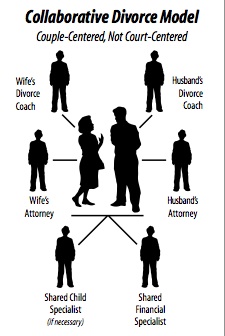
What does collaborative divorce look like?
The collaborative divorce model utilizes a team approach. Each spouse utilizes a team approach. Each spouse has an attorney and a divorce coach, and they share the services of a financial specialist.
If children are involved, they can also share a child specialist. In the next few blog posts, we'll look at the roles of each team member.

The collaborative divorce model utilizes a team approach. Each spouse utilizes a team approach. Each spouse has an attorney and a divorce coach, and they share the services of a financial specialist.
If children are involved, they can also share a child specialist. In the next few blog posts, we'll look at the roles of each team member.
Subscribe to:
Posts (Atom)